
essay · № 9
Beyond the Gutenberg Galaxy
AI can widen the conversation of civilization. The work of cultivating judgment remains ours.
Cover: AI-generated with OpenAI image generation — prompt
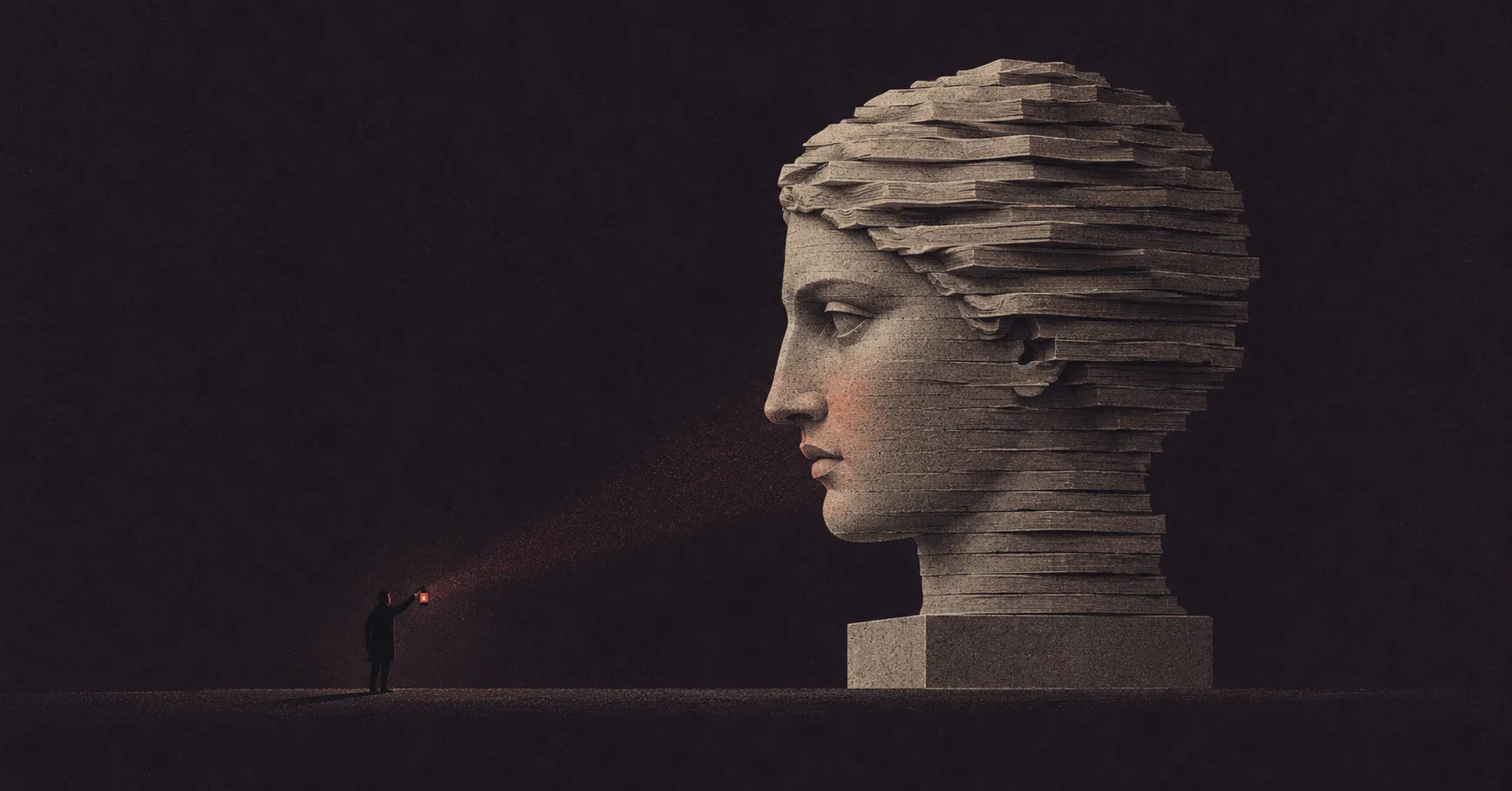
Use case: stylized-concept. Asset type: original editorial essay cover for The Reducing Valve, also reproduced as a full-width body illustration. Wide landscape approximately 1.91:1. Primary request: Illustrate the essay Beyond the Gutenberg Galaxy: the danger of projecting human wisdom onto fluent artificial intelligence, using Pygmalion as the metaphor. Scene: a vast quiet near-black aubergine field. A classical sculpted stone head on a plain short plinth occupies the right-of-center middle of the frame, in profile facing left. Its mass is constructed from tightly stacked narrow horizontal pale limestone planes, like the strata of printed pages, subtly interrupted with dark gaps. Its eye is simply carved stone and does NOT glow. A very small human silhouette at the lower left holds one tiny warm vermilion light. A narrow faintly visible beam from that HUMAN light brushes the statue's otherwise inert cheek: the apparent life comes from the observer. The human and statue remain distinct, with a large quiet gap. Style/medium: sophisticated literary magazine conceptual illustration, flat cut-paper shapes with tactile risograph and dry ink grain, restrained mid-century graphic composition. Symbolic and spare, not photorealistic or glossy 3D. Color palette: ONLY deep aubergine-black #1c1721 ground, muted limestone-grey #b5aca0 forms, one small warm vermilion #db624a accent at the human-held light with a very restrained reflected trace. Dark ground dominates. Composition: generous negative space across the upper and left field; keep the face and human light in the central horizontal band so a cinematic website cover crop remains intelligible. Fine paper grain across all surfaces; strong silhouette at thumbnail scale. Constraints: no text, no letters, no pseudo-writing, no typography, no logos or watermark. No robot, circuits, brain, network nodes, starfield, religious symbols, ornamental columns, or glowing statue eyes. One cohesive image, no panels.
When Johannes Gutenberg’s press began spreading through fifteenth-century Europe, it changed more than the cost of a book. It changed the conditions under which people encountered knowledge: what they could consult, compare, carry away, and read alone.
Marshall McLuhan called the civilization that emerged from this transformation the Gutenberg Galaxy. His claim was that a medium does more than transmit ideas. It cultivates habits of perception. The printed page favored sequence, repeatability, and the separation of an argument from the person speaking it.
These were extraordinary gains. Readers could return to a proposition, examine it at leisure, and challenge an authority against its own words. Print widened access to inherited knowledge while helping create the conditions for its criticism.
But every intellectual instrument makes some practices easier than others. The question is what happens when the habits it encourages become our default account of thinking itself.
Print did not single-handedly produce the Enlightenment, the Reformation, or the specialized university. Nor did it abolish conversation. It helped establish an environment in which private reading, textual authority, and increasingly specialized bodies of knowledge could flourish. Analytical power expanded. The work of connecting knowledge across fields, and relating it to the purposes of a life, became harder to locate.
The contrast should not be romanticized. Premodern intellectual life was neither uniformly wise nor free of narrowness. Yet the classical tradition preserved a distinction that remains useful: knowing something and knowing how to live with it are different achievements.
Plato’s dialogues ask readers to follow an inquiry in which answers remain open to challenge. They are written works that turn us toward the activity of questioning together. Aristotle’s account of phronesis, practical wisdom, concerns the capacity to judge and act well in particular circumstances. General knowledge matters, but no general rule relieves a person of the responsibility to discern what this situation requires.
These practices survived the age of print. The question is whether our institutions still give them the time and authority they need.
AI makes that question newly urgent.
A language model can move between subjects faster than any individual reader. It can place a philosophical argument beside a scientific finding, explain an unfamiliar vocabulary, or suggest a connection that would otherwise remain unnoticed. These are real intellectual possibilities.
They also introduce a particular danger. A connection can sound convincing before anyone has established whether it holds. Differences between disciplines can disappear inside a fluent paragraph. A disagreement about fundamental assumptions can be presented as though it were merely a difference of terminology.
The problem is not that AI can never help us synthesize. It is that the appearance of synthesis is easier to produce than its achievement. Someone must still examine the connection, test the evidence, and decide which differences cannot honestly be reconciled.
One danger is a monoculture of fluency: prose in which uncertainty, local experience, and unfamiliar ways of thinking are smoothed into the same confident register. We may become accustomed to answers that are easy to receive precisely because they make too few demands on us.
Pygmalion offers an image for this temptation. Before Venus brings his statue to life in Ovid’s story, the sculptor has already fallen in love with the figure he made. He encounters his own workmanship as the promise of another presence.
That earlier moment is the one to hold in mind. A system speaks coherently, responds attentively, and appears to understand. We supply expectations that its performance alone cannot justify. Whether or not we call such a system intelligent, eloquence is insufficient evidence of wisdom.
The danger is that we mistake its fluency for judgment, and gradually stop exercising our own.
AI-generated with OpenAI image generation — prompt
Use case: stylized-concept. Asset type: original editorial essay cover for The Reducing Valve, also reproduced as a full-width body illustration. Wide landscape approximately 1.91:1. Primary request: Illustrate the essay Beyond the Gutenberg Galaxy: the danger of projecting human wisdom onto fluent artificial intelligence, using Pygmalion as the metaphor. Scene: a vast quiet near-black aubergine field. A classical sculpted stone head on a plain short plinth occupies the right-of-center middle of the frame, in profile facing left. Its mass is constructed from tightly stacked narrow horizontal pale limestone planes, like the strata of printed pages, subtly interrupted with dark gaps. Its eye is simply carved stone and does NOT glow. A very small human silhouette at the lower left holds one tiny warm vermilion light. A narrow faintly visible beam from that HUMAN light brushes the statue's otherwise inert cheek: the apparent life comes from the observer. The human and statue remain distinct, with a large quiet gap. Style/medium: sophisticated literary magazine conceptual illustration, flat cut-paper shapes with tactile risograph and dry ink grain, restrained mid-century graphic composition. Symbolic and spare, not photorealistic or glossy 3D. Color palette: ONLY deep aubergine-black #1c1721 ground, muted limestone-grey #b5aca0 forms, one small warm vermilion #db624a accent at the human-held light with a very restrained reflected trace. Dark ground dominates. Composition: generous negative space across the upper and left field; keep the face and human light in the central horizontal band so a cinematic website cover crop remains intelligible. Fine paper grain across all surfaces; strong silhouette at thumbnail scale. Constraints: no text, no letters, no pseudo-writing, no typography, no logos or watermark. No robot, circuits, brain, network nodes, starfield, religious symbols, ornamental columns, or glowing statue eyes. One cohesive image, no panels.
Yet the conversational form also creates an opening.
Walter Ong described the emergence of “secondary orality”: forms of technologically mediated speech that depend on the literate world while recovering some of the participatory qualities of oral communication. This is no simple return to an earlier culture. Nor does a written exchange with a model automatically become a Socratic dialogue.
Still, an interface that permits questions, objections, and revisions can support a different practice from the passive receipt of an answer. What matters is how the encounter is organized.
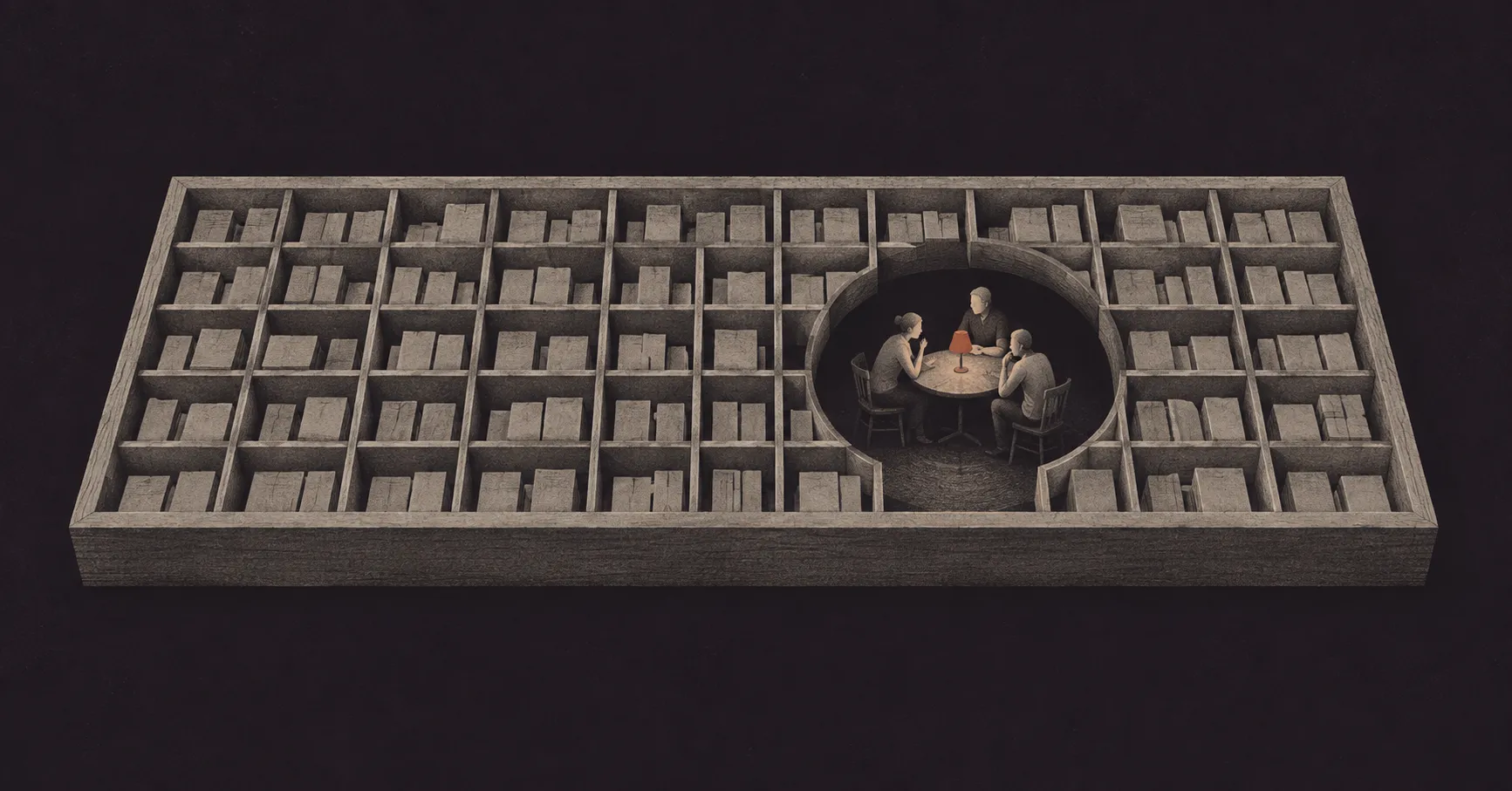
Imagine a reading group working through a passage of Plato. A model can explain an unfamiliar term, compare translations, or offer an objection to the group’s interpretation. Those contributions may deepen the discussion. But the participants still have to return to the passage, decide whether the objection is fair, and hear what another reader has noticed.
The same tool could also supply a polished interpretation that everyone accepts without reading further. The difference lies partly in the system’s design and partly in the habits, purposes, and relationships surrounding its use.
AI-generated with OpenAI image generation — prompt
Use case: stylized-concept. Asset type: original wide body illustration for The Reducing Valve essay Beyond the Gutenberg Galaxy. Wide landscape approximately 1.91:1. Primary request: a living circle of human inquiry opens a rigid printed grid, expressing the essay's claim that knowledge needs human conversation and judgment. Scene: viewed obliquely from above, a large antique printer's type case occupies the middle band of a vast near-black aubergine field. The shallow rectangular tray is a precise grid of narrow compartments holding orderly small abstract blank limestone-grey blocks. NO glyphs on any block. Near the right half, one circular opening interrupts the rigid grid: the straight partitions end at its boundary. In that opening, three very small distinct human silhouettes sit around a modest round table, leaning toward one another in conversation, each with a slightly different posture. A single tiny warm vermilion lamp at the middle of the table is the only warm accent. Human scale is intimate; this is a conceptual image of a conversation inhabiting and altering an inherited structure. Style/medium: sophisticated literary editorial illustration, flat cut-paper shapes, tactile risograph screenprint and dry ink grain, quiet mid-century graphic composition, spare and readable, not photorealistic or glossy 3D. Color palette: ONLY deep aubergine-black #1c1721 ground, muted limestone-grey #b5aca0 structure and figures, one small warm vermilion #db624a lamp. Use tonal variations within these hues only. Dark ground dominates, plenty of breathing room around the tray. Composition: wide landscape; main tray and human group near the vertical center; tiny warm accent draws attention to the living people rather than the architecture. Avoid excessive miniature detail. Clearly show three people around the table and the physical interruption of the rectangular compartments. Constraints: no text, letters, numbers, glyphs, pseudo-writing, logos, watermark. No computer, robot, circuits, religious symbols, floating speech bubbles, infographic arrows, collage panels, or additional accent colors. One cohesive image.
This requires a more careful claim than saying that AI cannot form a person. Technologies do shape us. A tool that repeatedly supplies our answers can alter our patience, confidence, and willingness to remain uncertain. If print helped form its readers, we cannot assume AI will leave its users unchanged.
What AI cannot adequately replace is the human responsibility for formation: the sustained work of cultivating judgment through education, friendship, community, living teachers, and encounters with realities that resist our wishes.
Formation is never finished. We do not become complete persons and then pick up our tools. We learn while using them, and sometimes discover that their convenience has weakened a capacity we meant to strengthen. Human guidance must therefore remain an ongoing practice.
The classical and Catholic tradition has resources for that practice. It asks what our abilities are for, which goods deserve pursuit, and how individual flourishing depends on our obligations to others. Its contribution to the digital age must be demonstrated in education and shared inquiry, wherever technical possibility requires a judgment about human ends.
Pope Leo XIV’s Magnifica Humanitas offers one expression of this encounter. Its discussion of education recognizes that technologies shape their users and that learning requires patience, relationships, and time. It also calls for the integration of knowledge without abandoning the verification of facts. These principles give the appeal to wisdom a practical direction: cultivate connections, examine them carefully, and protect the conditions in which people can learn to judge.
The harder work is to translate those principles into classrooms, communities, and the design of AI systems themselves. An appeal to tradition becomes useful when it changes what we practice.
Going beyond the Gutenberg Galaxy means carrying its achievements into a fuller practice of inquiry. Close reading, analytical rigor, and the scrutiny of evidence remain indispensable. Their purpose is fulfilled when what we know informs how we live.
AI will help shape the people who use it. We must take responsibility for that formation: cultivate attention, sustain communities of inquiry, and learn to judge which ends deserve our intelligence. The opportunity is immense, but it asks something of us. We cannot recover the practice of wisdom while outsourcing the effort of becoming wise.
The statue is capable of more than we have yet asked of it. So are we.